

Across the continent and its diasporas, African storytelling is undergoing a quiet but decisive transformation, one that moves it beyond the page and into voice, technology, and new cultural infrastructures that are reshaping how stories are created, shared, and experienced.
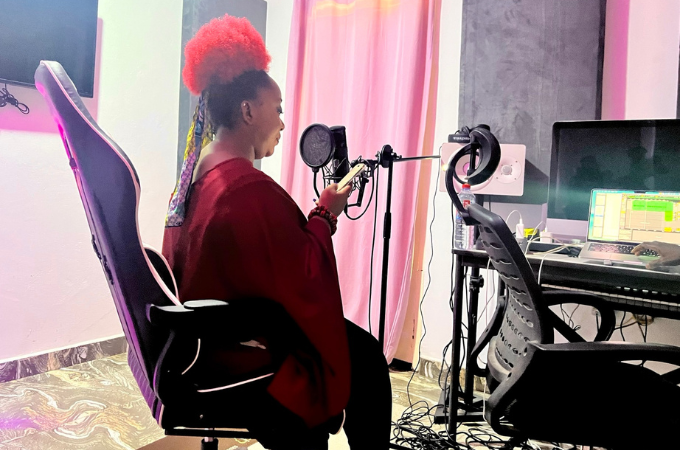
In a recording studio in Accra, a measured, lyrical, and unmistakably Ghanaian voice rises. This is where stories are no longer confined to print; they are being reimagined as sound, rhythm, and presence.
Across from me sits Apiorkor Seyiram Ashong-Abbey, a poet, media practitioner, TED speaker, and one of the most compelling voices shaping contemporary African literary culture. Leaning into the microphone, phone in hand, she shapes each sentence with precision, attentive to cadence, weight, and emotional resonance.
Apiorkor describes herself as a storyteller “in verse, in voice, and in vision.” Her practice moves fluidly across poetry, journalism, activism, and performance, a form she calls Verse Journalism, which fuses artistic expression with social commentary while resisting the containment of fixed genre boundaries. In her delivery, she is not merely reading text but activating it, returning it to a long tradition of African orality in which meaning is inseparable from breath, presence, and performance.
For me, the turn toward audio is also personal, shaped by my mother, a children’s book author who later lost her sight. That moment reframed a simple but urgent question: what happens to stories when those who need them most can no longer access the written page? From that question emerged the early foundations of AkooBooks Audio, a platform built on the belief that African literature must be accessible through voice as much as through text.
Across much of the continent, access remains one of the defining barriers to reading culture. Books are often expensive, distribution networks uneven, and payment systems fragmented across borders. Yet audio offers an alternative pathway, one that meets audiences where they already are, through mobile-first listening habits that are increasingly central to everyday life.
For many listeners, audio is not an aesthetic preference but a practical necessity. Platforms like AkooBooks are designed to work across African markets and diasporic communities, using subscription models, curated catalogues, and telecom partnerships to rethink how stories circulate. In this sense, audio is not simply innovation layered onto literature; it is a return to older, communal modes of storytelling adapted to contemporary infrastructure.
My work extends beyond the continent as Audio Ambassador for the Frankfurt Book Fair (2025–2026), where I engage publishers, platforms, and technology companies in conversations about the rapidly expanding global audio economy. The Frankfurt Book Fair remains one of the central nodes of the publishing world, a place where debates about access, technology, and authorship increasingly intersect with questions about equity and representation in global literary circulation.
In these spaces, one question recurs with increasing urgency: as audio markets expand, whose stories are being amplified, and whose remain unheard?
AkooBooks Audio is not simply a distribution platform but a reimagining of literary creation itself. Back in the studio, production unfolds as a process of interpretation rather than replication. A microphone, acoustic panels, and repeated takes become part of a delicate negotiation between text and voice. What emerges is not a mechanical reading but a lived experience, shaped by breath, pause, hesitation, and rhythm.
For artists like Apiorkor, whose work already inhabits performance, audio is not an adaptation but an extension of form. Her poetry, which has travelled through TED stages, international festivals, and multidisciplinary performance spaces, finds in audio a space that preserves its intimacy while expanding its reach. In the studio, that presence becomes more focused, more interior, yet no less powerful.
Audiobooks, in this sense, restore core elements of African storytelling traditions: voice as archive, cadence as structure, and emotion as meaning. They are not secondary formats but primary acts of transmission, carrying literature into new spaces of listening—headphones, classrooms, taxis, markets, and diasporic homes scattered across continents.
Across the growing catalogue of African audiobooks now being produced and distributed through platforms like AkooBooks Audio, a new literary ecosystem is beginning to take shape. Contemporary writing sits alongside oral histories, memoirs, and cultural archives, forming a living archive of African voice in motion. Among these is Mr. Music Man: The Journey, the life story of Ghanaian music legend Kojo Antwi, which brings one of West Africa’s most enduring musical figures into the audio space for both local and global audiences.
What is emerging is not simply a new format for literature but a shift in literary consciousness itself, one in which African stories are no longer constrained by the boundaries of print economies or geographic distribution. Instead, they move through voice, across platforms, and into the evolving infrastructures of global listening.
And if you listen closely, beneath the studios, the platforms, and the technologies, what becomes audible is something older and more continuous: the sound of African storytelling adapting once again, and already shaping its future.