

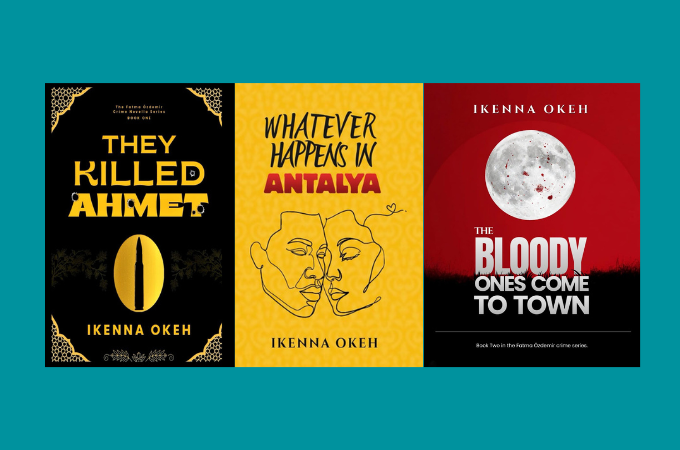
When they say books will take you places, they mean books will make you know places. This was me when I nosedived into Ikenna Okeh’s romance novel, Whatever Happens in Antalya, and two crime novellas, They Killed Ahmet and The Bloody Ones Come to Town, all set in Türkiye.
In Whatever Happens in Antalya, the reader is introduced to the main character, Michael, a 30-year-old Nigerian. He packs his bag and travels to Türkiye on a three-month tourist visa. To each his own, but if I were Michael, I would make every second count, visiting ancient and eye-inviting places, tasting diverse cuisines, and meeting people. Michael had similar plans, but he was on another level. Or what do we make of a young man in the company of four 50-year-old women from different walks of life?
The book begins with Diane, one of the women, quoting a saying that “Antalya is one of the easiest places where one can find sex.” You will be surprised that the opening line would perhaps be the last time you see the word ‘sex’ in the 207-page book. Despite being a book heavy on romance and eroticism, it is beautiful how the writer draws poetic, seductive phrases from his scabbard without being overly raw. When asked about the inspiration behind the book, Ikenna said the idea came to him after reading a passage in The Bluest Eye. According to Ikenna, “Toni Morrison described a lovemaking scene. It was eroticism delivered without vulgarity, and it made me wonder at the skill at play.” If Toni could achieve that in a passage, he took the challenge to see how much he could do with an entire book. Ikenna further documented that a major material that helped in writing the book was Naiwu Osahon’s Sex is a Nigger. He particularly liked the book for its ‘unseriousness’ and pure literary entertainment.
Antalya fascinates many tourists because of its “stunning scenery and Mediterranean bliss,” and Ikenna seductively described it in Whatever Happens in Antalya. If Antalya’s fame could have lured Cleopatra all the way from Egypt, it could lure anyone. It is the same way Ikenna’s romance novel seduced me, an anti-romantic. When asked why Antalya, Ikenna said, “Antalya is a city that comes alive with fun, adventures and experiences, and I thought that it was best I wrote a novel that’s purely entertaining, set in the moment of my sojourn in the city.”
Speaking of his sojourn in Türkiye, one may think Ikenna sneaked himself into Whatever Happens in Antalya. The reason is not far-fetched. Ikenna travelled to Türkiye for the first time in September 2020. It was shortly after international travel resumed in Nigeria following the COVID-19 lockdown. In his words, “The lockdown did a thing to everyone’s minds, you know. So I couldn’t wait to travel and feel free again.” Similar to Michael’s experience, the first city Ikenna spent some days in was Istanbul, after which he took a domestic flight to experience the beauty of Antalya. It appeared this particular book wore a cloak of verisimilitude, mirroring a part of Ikenna’s lived experience in Antalya. In his defence, Ikenna emphasised that some of his stories were spun from keen observations. According to him, “I write with the intention of wanting an insider familiar to my subject matter to truly respect the fact that I put in the effort to understand whatever issue I seek to address.”
This appearance of verisimilitude also finds its way into They Killed Ahmet, the first book in the crime novella series. In They Killed Ahmet, Ikenna cited the 2023 news report about a storage facility bust in Istanbul where a billion dollars in counterfeit notes were being held for transport to Africa. Set in Istanbul, the Lagos of Türkiye, They Killed Ahmet is a book about Fatma Özdemir, a curious 38-year-old police officer who just graduated from the police academy. Her first assignment was to uncover a homicide case where the suspect was nowhere to be found. Istanbul, being the economic and cultural seat of the country, introduced us to a landscape big enough to hide Huseyin, the prime suspect. Some purport that the book’s title gave away a key detail, as everyone knew from the onset that Ahmet was killed (the co-police officer on the homicide case). I shared the same sentiments after reading. However, I stumbled upon Ikenna’s interview with Literature Voices and understood his intent. Ikenna opined that while Ahmet is not an important character, his death offered a pivot for the plot – Fatma’s motivation to pursue the mafia. If the title had been “They Killed Fatma”, it would have given away a major plot. If anything, Ahmet’s character could have been more developed so readers could feel his death.
However, something beautiful is how Ikenna blends characters from different climes—Turkish, Nigerian, Iranian, Russian. This pattern is not just evident in They Killed Ahmet and The Bloody Ones Come to Town; it is also present in Whatever Happens in Antalya, where countries such as Nigeria, France, Saudi Arabia, Zimbabwe, and Morocco are mentioned. The diverse countries with distinct cultures provide the reader with a broad, unique experience of place. Ikenna wants the reader to have a glimpse of other regions, beyond the Turkish and Nigerian experience.
The second book in the crime series, The Bloody Ones Come to Town, is a fast-paced one. Unlike They Killed Ahmet, the second book is set in Antalya. As a police officer transferred from Istanbul to Antalya, Fatma is met with resistance from the media and police because of her linkage with the Russian mafia after solving the big case in They Killed Ahmet. I had high expectations for the second book in the series. While I was not utterly disappointed, the plot could be better developed. For instance, beyond wrapping the death of Elif Balik around Fatma, there was no connection between the woman and her husband, Cemil Balik, in the book’s bigger picture. Yet, they seemed like the next big thing when they were introduced. It is a crime novella, but I did not quite feel the thrills of a blood bath. Nonetheless, the book appears promising.
The author has hacked the descriptions of Antalya. The Bloody Ones Come to Town starts with a dead man washed up on the beach. The contrast in the excitement and merriment of the beach in Whatever Happens in Antalya suddenly feels different. It is wild how a place could house paradise and death. I feel there is less description of Istanbul in They Killed Ahmet, except for the depictions of high-rise buildings, traffic congestion, and hills in a few places. Since Istanbul is described as the Lagos of Türkiye, I wanted to see the Banana Island and Makoko of Türkiye, the hustle and bustle of a city big enough to consume you. Understanding the inspiration behind Whatever Happens in Antalya, I asked the author for the motivation behind the Fatma Özdemir crime novella series: “The idea came during a phone conversation with Onyeka Nwelue. I think he was congratulating me on the success of Rogues of the East, and then he went on to suggest that I write a crime series set in Türkiye.” You will agree with me that everyone needs someone like Onyeka in their circle. Someone who believes in you and pushes you to try out something.
This motivation has birthed a skyscraper of dreams as Ikenna has more plans for the crime novellas. Book three in the Fatma Özdemir series is set in Izmir, which is projected to be published in 2027. According to Ikenna, “Izmir is a beautiful city, strategically positioned on the Aegean coast. Setting this story in such a place will bring a new adventurous feel to the series.” It is safe to say that Africans can experience Türkiye in diverse forms through the lens of Ikenna Okeh. He has positioned himself as the African writer sharing the Turkish experience, and he is not backing down anytime soon. For the Fatma Özdemir crime novella series, Ikenna notes that the series is meant to be a seven-book series with each instalment set in a particular Turkish city. With the third location known, who knows where the fourth one will be, Ankara, maybe?
I asked Ikenna how he balances writing for his African audience with capturing the subtleties of the Turkish experience. In his words, “I have learned the politics of translation—not only of texts, but of cultures; at the core of which is language, food, and values.” He further stressed that, “I have become the first of my kind bringing the Turkish experience to African consciousness, therefore I saw myself saddled with the responsibility to put to use all that I have learned in translating much of the Turkish experience to Africans in a manner that they can relate to without being guilty of the grave age-long crime of gross misperception.” I was marvelled when he mentioned how many Africans and Europeans still think that Turks ride on camels. Surprisingly, some Nigerians are shocked to learn that “Turks are, on the average, more secular than Nigerians, that they drink beer, smoke, party and wear skimpy clothing that would get you publicly assaulted on the streets of Lagos in broad daylight.” His motivation is noble knowing that his goal is to “inform and entertain without committing the cultural crimes of genocidal proportions that have defined Africa through Eurocentric lenses.”
As a pioneer in writing about the Turkish landscape from an African migrant’s perspective, Ikenna sees other writers joining him in documenting this experience. “Any writer who passes through Turkiye is sure to find themselves writing about Turkiye. This place leaves a certain impression on the mind, you know,” he said. When I asked for that one Turkish nuance he is proudest of capturing accurately in his prose, his answer was straightforward. He said, “I think it will be the Turkish affinity for çay (tea).” Çay is considered the cornerstone of Turkish social culture, with Türkiye holding the world’s highest per-capita tea consumption. In my case, it will be ‘merhaba,’ meaning hello. It was the first word I memorised while reading Whatever Happens in Antalya.