

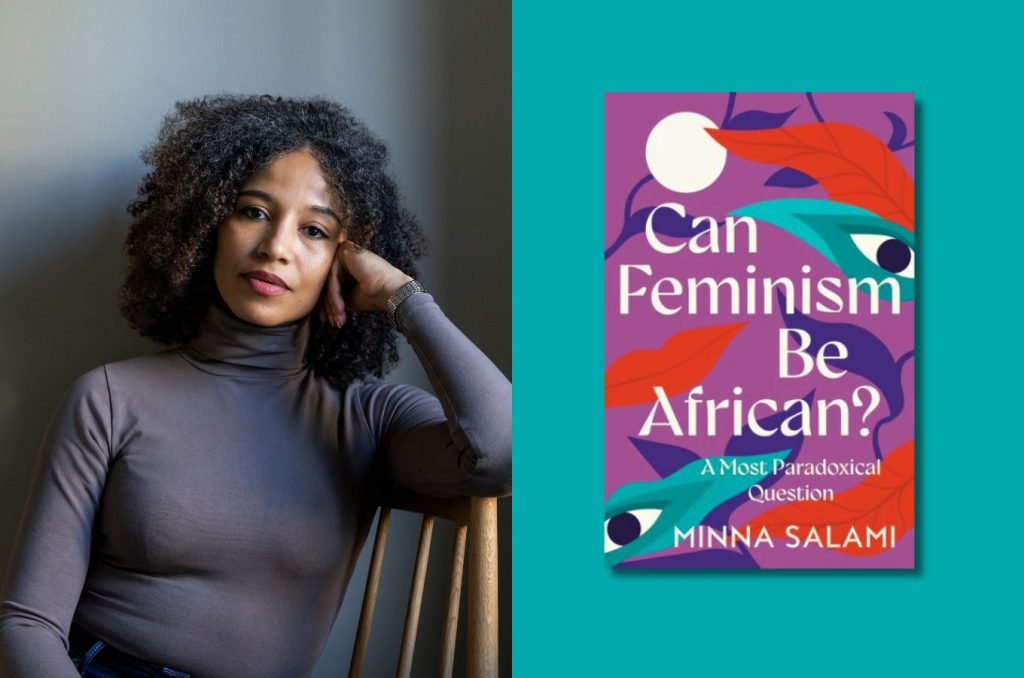
In the weeks before I began teaching my literature course The Art of African Feminist Writing, I picked up Minna Salami’s new book Can Feminism Be African? The timing felt almost instructive. I was already thinking about how African feminists have, across generations, repeatedly returned to the question of what African feminism is, and Salami’s book enters that long, unfinished conversation with both clarity and restraint.
With this book, Salami positions herself within a lineage of feminist thought that is at once literary, political, and deeply personal. Buchi Emecheta once referred to “feminism with a small f,” grounded in the textures of everyday survival and lived experience. Chimamanda Ngozi Adichie, through We Should All Be Feminists, helped translate feminism into a global conversation. June Eric-Udorie’s Can We All Be Feminists? pushed that conversation toward intersectionality, while B. Camminga’s Feminism Is for Every Body further expanded its reach into queer and trans embodiment. Salami does not attempt to overwrite these interventions; instead, she reads alongside them, extending the line of questioning rather than concluding it.
Her feminism is both philosophical and affective. She invites us to think of Africa not only as a mapped and measurable continent, but as something more porous and unstable, an idea that circulates through language, memory, and imagination.
“Africa is not only a tangible place that we can map out,” she writes, “but also a non-material ‘place’ populated with beliefs, ideas, desires, emotions, and ideas that we have yet to articulate… In its totality, the Africa in African feminism is metaphysical. It is a metaphysical Africa.”
This framing allows Salami to shift African feminism away from purely institutional or policy-driven readings of gender justice. Instead of reducing feminist struggle to technocratic language or development frameworks, she resists what she sees as the flattening of lived experience into managerial categories.
“An African feminist political philosophy must unpack, deconstruct, dismantle, build and rebuild reality… Yet the structured understanding of empirical Africa encourages us to break down feminism into issues that can be ‘fixed,’ often through NGOs and development work. I am always left cold when policy-speak turns our struggles, dreams, and hopes into techno-bureaucratic jargon.”
Against this, Salami proposes a feminism that is animated by imagination rather than constrained by it, insisting that creativity is not ornamental but structurally necessary to feminist thought.
“The impulse to be inventive and creative may not seem apt for the serious nature of the issues African feminism addresses,” she writes, “however, rigid and dogmatic certainties lie at the root of domination and stagnation… To understand any topic deeply, we need to enliven the faculty of the imagination.”
Imagination, in this sense, becomes a political faculty, a way of refusing the limits imposed by inherited systems of meaning. The book repeatedly returns to this tension between structure and possibility, between what has been historically fixed and what might still be reconfigured.
This becomes especially visible in Salami’s engagement with binaries that have shaped both feminist and postcolonial discourse, including the separation of Africa and Europe, masculinity and femininity, tradition and modernity. Rather than attempting to resolve these oppositions, she examines how they continue to organise thought and constrain perception, asking what becomes possible when they are loosened rather than reinforced.
The final chapter, “The Pedagogy of Shakara,” offers the book’s most vivid conceptual gesture. Shakara, a Nigerian term associated with confidence, flair, and performative self-assurance, is reframed here not as superficiality but as a feminist mode of being. It becomes a way of inhabiting the world with joy that refuses apology, and with presence that resists diminishment.
In Salami’s hands, shakara is not excess but method, a form of self-possession that interrupts patriarchal expectations of restraint and legibility. It is also where the book’s intellectual argument meets its emotional register most directly, suggesting that refusal can also be pleasurable, embodied, and expressive.
By the time the book closes, what remains is not a definitive answer to its titular question, but a more deliberate suspension of closure itself. Can Feminism Be African? does not attempt to stabilise either “Africa” or “feminism” into fixed categories. Instead, it treats both as ongoing sites of thought, shaped by disagreement, revision, and imaginative expansion.
If there is a hesitation to be noted, it lies in the expectation generated by the book’s title, which suggests a sweeping redefinition where the text itself offers something more meditative and exploratory. Yet this restraint is also part of its method. Rather than delivering a singular theoretical intervention, Salami offers a sustained reflection on how feminist thought might remain open, responsive, and unsettled.
In a moment where political language often gravitates toward resolution, measurement, and closure, Can Feminism Be African? insists instead on the value of staying with the question, and on the generative potential of refusing to exhaust it.