

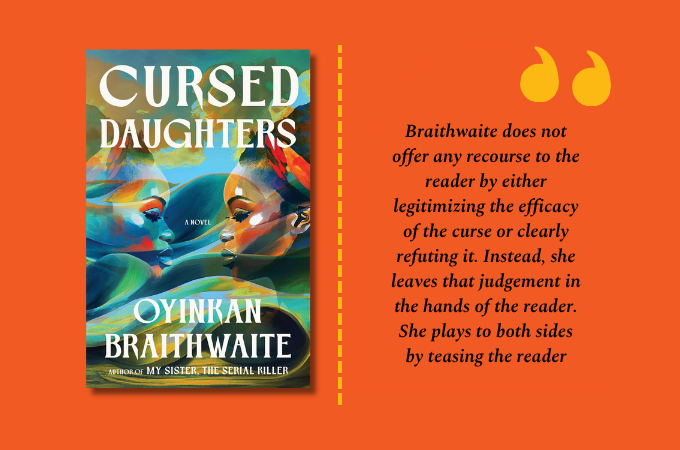
Oyinkan Braithwaite’s Cursed Daughters marks a decisive departure from the darkly comic tone of her critically acclaimed debut, My Sister, The Serial Killer, shifting instead into a multigenerational family saga structured around inheritance, superstition, and the persistent psychological weight of belief.
Focalized through three women, the cousins Monife and Ebun, as well as Ebun’s daughter Eniiyi, Cursed Daughters traces the lives of the Falodun women and their enduring inability to sustain successful marriages, a pattern attributed to a curse placed on their ancestor, Feranmi Falodun, by a betrayed first wife. The narrative begins with Feranmi’s secret marriage to a woman from the city, a union that ignites a violent confrontation between his first wife and his new bride during what was meant to be a simple burial trip to the village. In the aftermath of this encounter, the first wife utters a curse that becomes the novel’s haunting structural and thematic anchor:
It will not be well with you. No man will call your house home. And if they try, they will not have peace. Your daughters are cursed – they will pursue men, but the men will be like water in their palms. Your granddaughters will love in vain. Your great-granddaughters will labour for acknowledgement, but they will all fall short of other women. Your daughters, your daughters’ daughters and all the women will come to suffer for man’s sake. Ko ni dafun e.
And perhaps to intensify its symbolic force, she “wipe[s] the blood from one of her many wounds and smear[s] it on the ground.”
Even as the curse becomes a structuring principle across the lives of the Falodun women—the sisters Bunmi and Kemi, their daughters Monife and Ebun, and Ebun’s daughter Eniiyi—Braithwaite refuses to offer a definitive position on its reality. Instead, she sustains a deliberate ambiguity that leaves interpretation suspended between superstition and psychology, teasing the reader with Monife’s unsettling proposition that one might not believe in curses, but “what if the curse believes in you?” and Eniiyi’s more clinical speculation that:
[w]hat if the trauma of losing the love, stability and social standing that came with marriage had left epigenetic markers on generation after generation of Falodun women? What if the neurons in their brains were triggering her mother, grandmother and grand-aunt to select the wrong partner, and that was the ‘curse’?
These competing framings—one metaphysical, the other neurological—become the conceptual trap of the novel, shaping not only the women’s lives but also the reader’s interpretive movement through the text. The novel, in this sense, reflects a broader Nigerian postcolonial condition in which superstition and institutional religion coexist in uneasy proximity, producing a layered cosmology where belief is rarely singular. As such, the curse functions less as a literal supernatural force than as a narrative articulation of cultural doubleness, where Pentecostal Christianity and Islamic orthodoxy sit alongside inherited indigenous epistemologies, each surfacing when rational explanation fails.
Yet one might argue that the more insidious curse is not metaphysical at all, but relational: the persistent centrality of men in the emotional architecture of the Falodun women’s lives. Whether through Monife’s desperate attempts to secure love or Ebun’s equally desperate attempts to resist it, male presence—or its anticipated absence—becomes the axis around which desire, anxiety, and self-worth are organised. The tragedy of the Falodun lineage therefore emerges not only from inherited misfortune but from an inherited script of relational dependency, in which love is inseparable from fear, and attachment is structured by anticipation of loss.

Braithwaite’s use of music operates as a temporal and cultural cartography, anchoring each narrative strand in its historical moment. Songs such as Pliers’ “Murder She Wrote,” Snoop Dogg’s “Gin and Juice,” and even “Brandy’s crooning” situate the early 1990s with sonic precision, while the mid-2020s are marked by Burna Boy’s “Last Last” and “Gbona,” Teni’s “Case,” Lojay’s “Monalisa,” and Ayra Starr’s “Bloody Samaritan.” This shifting musical archive not only signals generational transition but also maps the gradual ascent of Afrobeats from local circulation to global prominence. The transitional period between the late 2000s and mid-2010s, in which Janet Jackson’s “Doesn’t Really Matter” coexists with Lagbaja’s “Coolu Temper,” becomes especially significant as a sonic space of hybridity, where imported and indigenous sounds circulate without clear hierarchy.
Despite this auditory evolution, Braithwaite simultaneously underscores the structural stasis of Nigerian socio-economic life. Across the decades separating Monife’s 1994 and Eniiyi’s 2025, infrastructural precarity remains stubbornly unchanged, most notably in the persistence of unreliable electricity. Repeated NEPA outages, described as “arbitrary and […] becoming more and more frequent,” disrupt domestic life in ways that persist into the present, where Eniiyi finds herself “hot and irritable” in a powerless household. The novel thus stages a temporal paradox in which cultural production evolves while infrastructural conditions stagnate.
This tension extends into Braithwaite’s depiction of governance and civic life, where political disillusionment becomes a shared generational affect. Conversations about the presidency are marked by “the disappointment that was the president’s run thus far; the seemingly arbitrary decision to change the national anthem whilst his citizens faced economic crisis; the lack of hope in the political process.” Even moments of crisis, such as Zubby’s drowning at the beach, are refracted through institutional absence, as Eniiyi realises that there is no clear emergency system in place: “It dawned on her that they should call an ambulance, but she had no idea what the number was for that or if there was even a number to call.” In this way, the novel’s private tragedies are continually shadowed by public infrastructural failure, situating personal grief within systemic neglect.
Braithwaite’s deployment of Nigerian Pidgin, however, is less successful. While the novel strives for linguistic authenticity, the dialogue attributed to figures such as Mama G often feels externally imposed rather than organically embedded in the speech rhythms of Nigerian multilingual life. Phrases like “I cannot resell am,” rather than the more fluid “I no go fit sell am give another pesin,” reveal a syntactic stiffness that disrupts narrative immersion. Similarly, utterances such as “E don happen in the spirit world” and “No be small matter at all; but I can start to beg the gods for her sake” lack the tonal elasticity characteristic of lived Pidgin usage. Rather than enriching characterisation, these moments risk flattening it, particularly in the case of Mama G, who might otherwise have functioned as a richly textured spiritual intermediary but instead remains partially estranged from linguistic credibility.
Nevertheless, despite these tonal inconsistencies, Cursed Daughters affirms Braithwaite’s continued interest in the psychological architectures of family, inheritance, and female interiority. The novel’s true achievement lies in its sustained refusal of resolution, instead staging entrapment and agency as coexisting forces within the same generational continuum. Through its closing imagery—Monife submerged in the ocean confronting the inherited curse, and Eniiyi suspended within the liminal space of flight—the novel gestures toward both rupture and persistence. Even when cycles appear inescapable, Braithwaite suggests, survival itself becomes a form of defiance, and endurance a quiet but unmistakable triumph.